As if you were there.
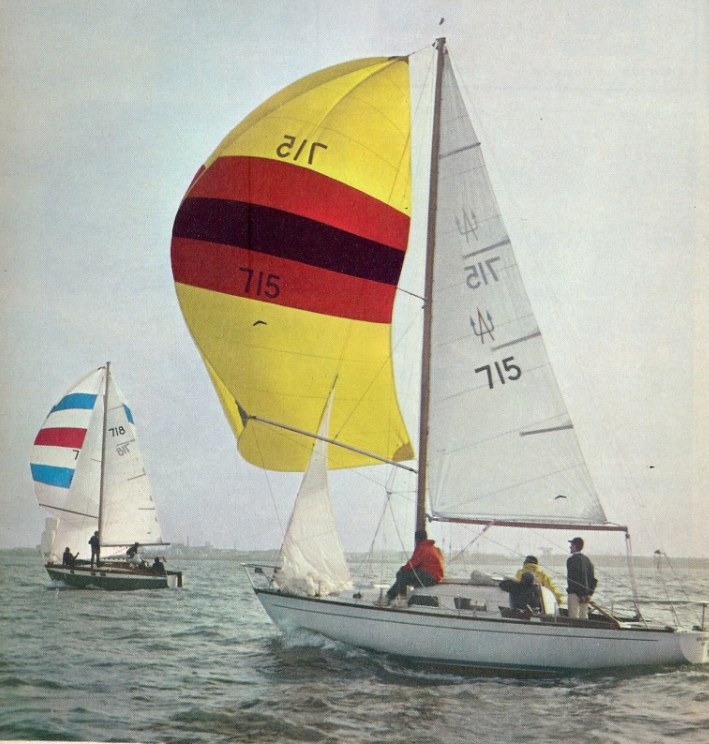
"Raki" wins the first Half Ton Cup
Late August 1966, in the sheltered waters between La Rochelle and the islands of Ré and Oléron. Nine small cruisers are entered for a brand-new event: the Coupe Internationale Atlantique for 18-footers. Seven will make the start. The English are already calling it the "Half Ton Cup". After three races, two Armagnacs designed by Philippe Harlé finish level on points, at the end of a remarkable duel.
A cup for 18-footers
La Rochelle has barely finished its International Week when the Société des Régates Rochelaises, together with the Cercle de la Voile de Paris, goes again. The idea is simple and borrowed from the One Ton Cup: race cruising yachts measured under the RORC rule boat-for-boat, with no handicap and no corrected time. But where the One Ton Cup calls for 22-foot-rated Class III boats, often ruinously expensive, the new cup is for Class IV: an 18-foot rating, under 7.32 m on the waterline. First across the line wins. Everyone understands.
Ostend on the line
Nine boats are entered, from six clubs: the Société des Régates Rochelaises, the Cercle de la Voile de Paris, the Société Nautique de la Trinité, the Société des Régates de Royan, the Centre Nautique de Saint-Nazaire… and the North Sea Yacht Club of Ostend. Two miss the start: one is weather-bound in Paimpol, the other cannot find a crew. Seven, then, on the line.
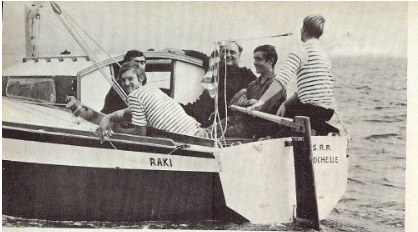
First to catch the eye are two Armagnacs, designed by Philippe Harlé and built in double-chine plywood by the Arié-Vernazza yard. Raki belongs to a La Rochelle doctor, Dr Montaubin; aboard Iskra II, Harlé himself is sailing, with René Sencé.
Georges Auzépy-Brenneur fields two very different designs: Atlante, in GRP, beautifully finished, and Ombrine, in plywood, whose mainsail carries the emblem of the GCL. Capella, drawn by the Dutchman Frans Maas, is a seven-ply moulded-wood boat, powerful and elegant; she belongs to the Vanek family, and Maas has come from Breskens to helm her. Drakkar comes from the SOPA yard in La Rochelle, developed from the Sanderling. And Woops, an Elizabethan 29 designed by the Englishman Kim Holman, flies the colours of Ostend: her owner is Wauquiez, with Houbard at the helm.
30 August · First race inshore
| 1 | Iskra II | 12:08:04 |
| 2 | Raki | + 1 min 38 s |
| 3 | Atlante | + 9 min 41 s |
| 4 | Capella | + 10 min 46 s |
| 5 | Drakkar | + 19 min 40 s |
| 6 | Ombrine | + 24 min 32 s |
| 7 | Woops | + 39 min 05 s |
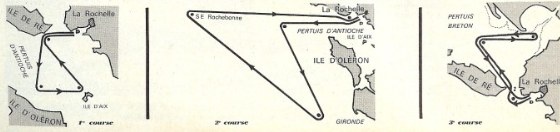
The start is at 8.15 am, on starboard tack, in a light west-south-westerly, force 2. The course links the Pointe de Chef de Baie, the Chauveau buoy and the Île d'Aix. Both Armagnacs choose to point high and lay Chauveau, while their rivals have to tack to reach it. The gamble pays: Iskra II is first across the line at 12:08:04; Raki follows 1 minute 38 seconds later.
31 August · 150 miles offshore
| 1 | Raki | 15:18:02 |
| 2 | Iskra II | 15:56:05 |
| 3 | Capella | 17:14:30 |
| 4 | Atlante | 19:30:07 |
| 5 | Drakkar | 20:02:46 |
| — | Ombrine, Woops | Retired |
The next day, the offshore race: 150 miles out to the Rochebonne bank and back. The start is at 9 am in a west-north-westerly of force 4 to 5, with a short sea and squalls closing down the visibility. Two seconds after the gun, Raki is on the line. Off Chauveau the waves reach two metres. Woops retires, her sails not drawing well; on Ombrine a crewman dislocates a knee and a spinnaker is torn to shreds: she heads home.
The leading group bears away too far and finds itself four miles below the BXA buoy. Iskra is the first to notice and climbs back up. But it is Raki who makes the difference: pinpoint navigation puts her right on the south-east buoy of the Rochebonne bank, while Atlante, too far out to sea, sails almost all the way round the bank. Raki crosses the line at 15:18:02, 38 minutes and 3 seconds ahead of Iskra II.
3 September · The duel
| 1 | Iskra II | 14:13:43 |
| 2 | Raki | 14:14:52 |
| 3 | Atlante | 14:21:59 |
| 4 | Capella | 14:25:26 |
| 5 | Ombrine | 14:35:17 |
| 6 | Drakkar | 14:45:17 |
| 7 | Woops | 15:17:10 |
The final race, thirty miles: Pointe de Chef de Baie, the Lavardin beacon, the Rocha buoy, the Aiguillon buoy. Atlante is first round the Lavardin, but the Armagnacs never let go. At the finish, Iskra II wins by 69 seconds from Raki: 14:13:43 against 14:14:52.
The two Armagnacs have shared the wins: two for Iskra II inshore, one for Raki offshore. Overall they are level on points, 28.5 each. The rules have foreseen it: the better place in the offshore race breaks the tie. Raki wins the Coupe Internationale Atlantique, the "Lord Granard Cup". On the quay, the crews of Raki and Iskra II throw Philippe Harlé into the water. He comes out delighted.
What La Rochelle learned
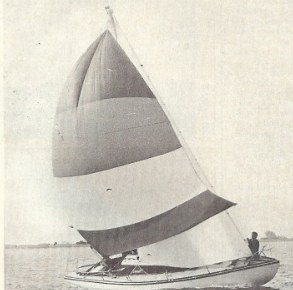
Boat-for-boat racing is a hit: no calculations, no arguments, first home wins. Above all, victory goes to real cruisers, comfortable and roomy. Plywood Armagnacs, a moulded-wood Capella, GRP hulls: boats you can take cruising have held their own on the race course. Some are already worried, though: will we see "machines" built only for the cup, expensive and useless for cruising?
Raki being from La Rochelle, the cup stays in La Rochelle. Frans Maas promises to return to defend the Dutch colours; the English, the Spanish and the Scandinavians are expected. The date is set for the 1967 "Half Ton Cup".
Technical sheets
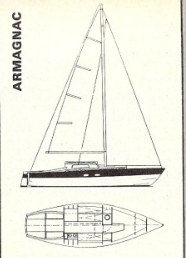
Armagnac
Raki · Iskra II
- Designer
- Philippe Harlé
- Construction
- Plywood, double chine
- Length overall
- 8.00 m
- Waterline
- 6.65 m
- Beam
- 2.67 m
- Draught
- 1.32 m
- Displacement
- 2 t
- Ballast
- Cast iron, 940 kg
- Sail area (with genoa)
- 36.55 m²
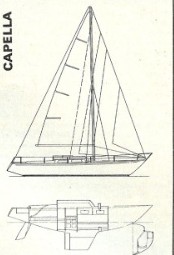
Capella
Capella
- Designer
- Frans Maas
- Construction
- Moulded wood, seven 3 mm plies
- Length overall
- 8.80 m
- Waterline
- 6.50 m
- Beam
- 2.60 m
- Draught
- 1.65 m
- Displacement
- 3,200 kg
- Ballast
- Cast iron, 1,700 kg
- Sail area (with genoa)
- 39.7 m²
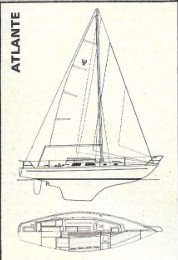
Atlante
Atlante
- Designer
- Georges Auzépy-Brenneur
- Construction
- Moulded GRP
- Length overall
- 8.47 m
- Waterline
- 6.40 m
- Beam
- 2.45 m
- Draught
- 1.30 m
- Displacement
- 2.5 t (loaded)
- Ballast
- Cast iron, 1,050 kg
- Sail area (with genoa)
- 35.77 m²
Drakkar
Drakkar
- Designer
- S.O.P.A.
- Construction
- Moulded GRP
- Length overall
- 9.00 m
- Waterline
- 5.90 m
- Beam
- 2.52 m
- Draught
- 1.36 m
- Displacement
- 2 t
- Ballast
- 900 kg
- Sail area (with genoa)
- 30 m²
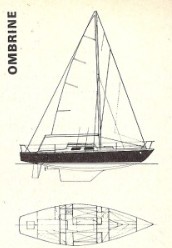
Ombrine
Ombrine
- Designer
- Georges Auzépy-Brenneur
- Construction
- Plywood, double chine
- Length overall
- 8.77 m
- Waterline
- 6.60 m
- Beam
- 2.74 m
- Draught
- 1.35 m
- Displacement
- 2 t
- Ballast
- 1 t
- Sail area (with genoa)
- 33 m²
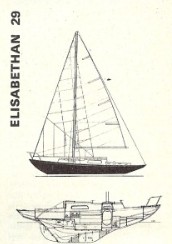
Elizabethan 29
Woops · N.S.Y.C. Ostend
- Designer
- Kim Holman
- Construction
- Moulded GRP
- Length overall
- 8.84 m
- Waterline
- 6.10 m
- Beam
- 2.32 m
- Draught
- 1.30 m
- Displacement
- 2,850 kg
- Ballast
- 900 kg
- Sail area (with genoa)
- 33.1 m²
Overall results
| Pos | Boat | Club | Owner | Points |
|---|---|---|---|---|
| 1 | Raki | S.R. Rochelaises | Arié-Montaubin | 28.5 |
| 2 | Iskra II | S.R. Rochelaises | Autin | 28.5 |
| 3 | Capella | S.N. Trinité | Vanek | 18 |
| 4 | Atlante | S.R. Rochelaises | Mallard | 18 |
| 5 | Drakkar | S.R. Rochelaises | Dechamp | 11 |
| 6 | Ombrine | C.V. Paris | Helmed by Bereni | 5 |
| 7 | Woops | N.S.Y.C. Ostend | Wauquiez, helmed by Houbard | 2 |
Raki and Iskra II, level on points, are separated by the offshore race.
Account based on the report by Jacques Courcel published in Nautisme magazine in 1966. Plans and technical data reproduced from the same publication. Photos by Gérard Beauvais. Translated from the French.